Blog
About the Tea Variety 'Izumi'
【Registered in 1960, Norin No. 24, History, Benihomare, Seedling】
'Izumi' was cultivated around 60 years ago as a variety of tea for export, specifically for pan-fired tea. At that time, Japan earned foreign currency through agricultural products such as silk and tea. The export destinations were said to be North Africa.
Soon after, Japan entered a period of rapid economic growth, and tea became focused on domestic consumption; exports began to decline, and 'Izumi' ended up being scarcely cultivated, becoming a phantom variety.
In Showa 31, the evaluation of 'Izumi' by the Japan Tea Export Association stated that it was “flawless in both shape and color, with an intense aroma and rich flavor, extremely good quality.”
The breeding site was the National Tea Experiment Station, Yame Branch in Fukuoka Prefecture at that time, but it is now closed.
The Trigger for Cultivating 'Izumi'
In 1991, while studying as a researcher at the National Tea Experiment Station in Makinohara City, Shizuoka Prefecture, I was searching for tea varieties with distinct aromas. At that time, I learned from the research officer, Shuichi Fukatsu, that 'Izumi' has a strong and unique aroma when withered and fermented among Japanese varieties.
At Yoshida Tea Garden, we started cultivating seedlings of 'Izumi' in 1992, and from 2000, we began full-scale planting. In 2008, we won the 'Gold Award' at the World Green Tea Contest with a set of withered sencha (created by Masahiro Yoshida) and oolong tea (created by Noboru Kimura).
From 2005 to 2010, we were producing 'Izumi's sencha and withered sencha. While having a sweet aroma and distinct characteristics, it also had astringency. I was thinking about how to convey the merits of 'Izumi' to our customers.
Turning 'Izumi' into Black Tea
In 2012, I decided to try making black tea to challenge myself and find hints for sencha production.
'Izumi's parent variety is the black tea variety 'Benihomare', so I thought maybe we could create delicious black tea. At that time, the number of producers making black tea from the same 'Sashima tea' area was also increasing.
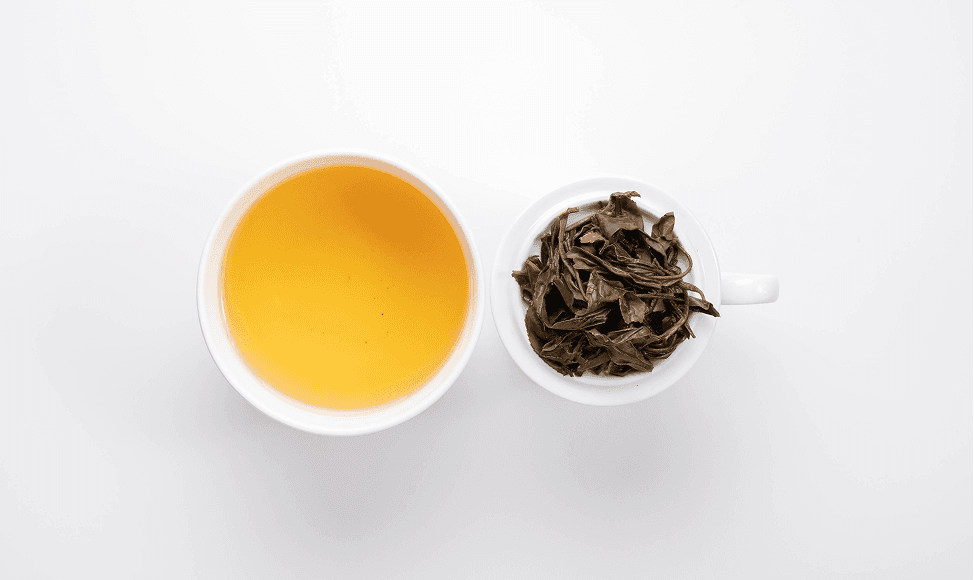
The 'Izumi black tea' I made for the first time in 2012 turned out fairly well. It was the moment I felt the potential of 'Izumi' as a black tea.
The Turning Point for 'Izumi' Black Tea
The turning point was at the 14th National Regional Black Tea Summit held in Shimoda City, Shizuoka Prefecture, in 2015. While setting up our booth, I had the opportunity to taste the black tea of Toshihiro Kajiwara from Kumamoto Prefecture at the adjoining booth.
Kajiwara’s black tea was clearly different in shape from other exhibitors, maintaining the shape of the leaves, had a sweet aroma with minimal astringency, a long aftertaste, and yet a refreshing taste; I remember being deeply impressed by this brilliance.
In 2016, when we participated in the (now) Japan Tea Festival held in Asakusa, Tokyo, I was introduced to Shiho Tokuda, one of the organizers, who encouraged us to reconsider our tea-making techniques.
I was surprised to learn that Tokuda was the person who conveyed production techniques to Kajiwara. His advice, having studied tea production in the Chinese region of 'Phoenix Dan Cong,' led to a comprehensive review of all processes from cultivation to plucking and finishing.
As a result, 'Izumi' transformed into a 'fragrant black tea that fully exhibits the charm of Izumi' which is distinctly different from past black teas.
'Izumi Black Tea' Wins Top Prize at Contest
In 2018, at the 'Japan Tea Festival' held in Asakusa, Tokyo, 'Izumi Black Tea' won the top awards of 5 stars and 4 stars at the 'Premium Tea Contest,' which had a total of 48 entries from around the country.
The judges for this contest were shop owners specializing in high-quality black tea in Tokyo.
Additionally, at the tasting tea popularity contest 'Fine Tea Contest' held simultaneously at the same 'Japan Tea Festival', we also won the top prize of 5 stars. This award is given to the top two among 58 tasting teas centered on both imported and domestic black tea, based on approximately 900 votes from customers on the day.
We also received support from general black tea enthusiasts, and I felt that the charm of 'high-quality Japanese black tea, Izumi' was conveyed.
In 2019, we similarly received 4 stars at the 'Premium Tea Contest' out of 78 entries and 5 stars at the 'Fine Tea Contest.'
In the 'Japan Tea AWARD,' we advanced to the Platinum Award, which is given to the top 20 among a total of 463 entries. During the third examination, participated by over 1,000 people across 8 locations both nationally and internationally,
we received the second prize, 'Japan Tea AWARD Sub Grand Prize.'
This is the first time a 'Sub Grand Prize' has been awarded in domestic black tea.
I feel that the improvement in the quality of black tea is significantly due to the training and advice obtained from many producers involved in black tea production and sales, centered around Tokuda.
I would like to express my gratitude to everyone who has supported us.
In Conclusion - The Future of 'Izumi'
In the future, it is expected that the opportunities for 'Japanese Black Tea, Izumi' will increase.
I sensed from the reactions at events that the 'Japanese IZUMI BLACK TEA,' made by Japanese people, receives support from foreign individuals due to its profound taste.
In fact, it is expected to receive high evaluations from overseas individuals as well. (Countries include the United States, United Kingdom, Taiwan, Russia, Indonesia, Romania, Germany, and India)
The phantom variety 'Izumi,' forgotten in the tea industry, is like a 'diamond in the rough' as a material for producing high-quality black tea. Over the past few years, I have strongly felt that many people expect a genuine revival.
Even in other production areas, 'Izumi black tea' has already begun to be produced, albeit in small quantities.
Through the phantom variety 'Izumi,' I hope to continue providing a cup of 'healing.'
Return to the article list